
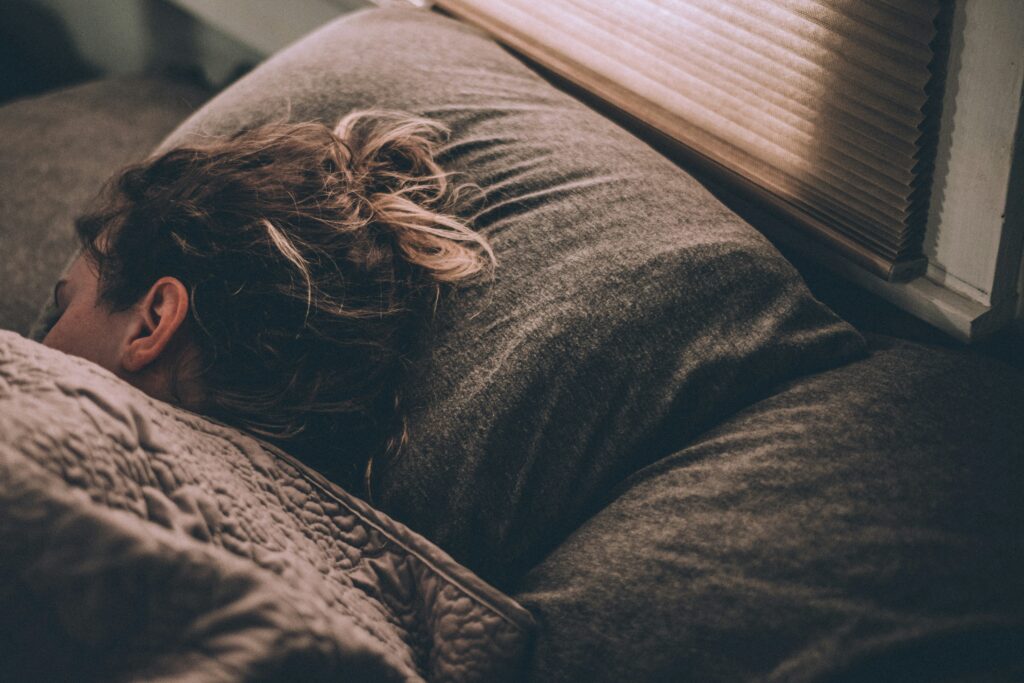
You are lying in bed. You are tired. The room is dark and quiet. And yet sleep refuses to come. Twenty minutes pass. Then forty. You check the time, calculate how many hours of sleep you will get if you fall asleep right now, and somehow this makes everything worse. Your mind races through tomorrow’s tasks, yesterday’s conversations, and a rotating cast of things you said ten years ago that you probably should not have.
This experience is more common than most people realize. If you regularly wake up exhausted despite sleeping enough hours, our guide on 7 real reasons you feel tired even after sleeping explores what else might be undermining your rest.
Research suggests that approximately 30% of adults regularly take more than 30 minutes to fall asleep — a problem that compounds over time as the frustration of lying awake makes sleep progressively more elusive.
The good news is that sleep onset — the process of transitioning from wakefulness to sleep — is not mysterious. It follows predictable biological patterns that can be deliberately influenced. This article explains the science of how sleep begins, why it sometimes fails to begin, and the specific evidence-based strategies that reliably reduce the time it takes to fall asleep.
How Sleep Actually Begins
Understanding why you cannot fall asleep requires understanding what sleep actually is and how it starts.
Sleep is not something your brain switches on. It is something your brain stops resisting. Throughout the day, a chemical called adenosine accumulates in your brain as a byproduct of neural activity. The longer you are awake, the more adenosine builds up, and the more pressure you feel to sleep. This is called homeostatic sleep drive — the biological force that makes you progressively sleepier as the day goes on.
Simultaneously, your brain follows a circadian rhythm — a roughly 24-hour internal clock regulated primarily by light exposure. In the evening, as light decreases, your brain begins producing melatonin, a hormone that signals to your body that night is approaching and sleep should begin. Melatonin does not cause sleep directly — it is more accurately described as the biological darkness signal that creates the conditions for sleep.
Sleep onset happens when two conditions are met: sufficient adenosine has accumulated to create strong sleep pressure, and the circadian clock is signaling that it is the right time to sleep. When these two systems align, falling asleep is effortless. When they are misaligned — because your circadian rhythm is disrupted, because adenosine has been blocked by caffeine, or because your nervous system is in a state of activation — sleep onset becomes difficult or impossible regardless of how tired you feel.
Everything in this article works by supporting one or both of these systems.
Why You Cannot Fall Asleep — The Real Reasons
Before addressing solutions, it helps to understand which specific factor is most likely causing your difficulty. There are four primary causes of slow sleep onset.
Circadian misalignment is the most common cause. Your internal clock is set to a different time than when you are trying to sleep — either because you have been sleeping at inconsistent times, because you have been exposed to bright light too close to bedtime, or because you are trying to sleep earlier or later than your natural chronotype allows.
Nervous system activation is the second most common cause. Your sympathetic nervous system — the fight-or-flight system — is still active when you get into bed. Stress, anxiety, stimulating activities, screen use, and even exercise too close to bedtime can keep this system elevated, making it physiologically impossible to sleep even when you are exhausted.
Caffeine interference is frequently underestimated. Caffeine works by blocking adenosine receptors — essentially masking your sleep pressure without eliminating it. Even afternoon caffeine consumed six to eight hours before bed can significantly impair sleep onset by reducing the adenosine signal your brain needs to recognize that it is time to sleep. The foods you eat also play a significant role in your sleep quality — discover the 8 foods that secretly drain your energy all day and how they affect your sleep.
Conditioned arousal is a learned response where your bed and bedroom have become associated with wakefulness rather than sleep — typically through years of lying awake in bed, using devices in bed, or working in bed. Your brain has literally learned to become alert when you get into bed.
7 Science-Backed Strategies to Fall Asleep Faster
1. Fix Your Sleep Schedule First
Everything else on this list is significantly more effective when you have a consistent sleep schedule. Your brain’s circadian clock is set primarily by the timing of light exposure and wake time — and consistency is what keeps it calibrated.
The single most impactful schedule change is committing to a fixed wake time every day including weekends. This anchors your circadian rhythm, ensures adequate sleep pressure has built up by your intended bedtime, and produces natural sleepiness at the right time.
Many people focus on what time they go to bed — but research consistently shows that wake time is more important. A consistent wake time produces consistent bedtime sleepiness. An inconsistent wake time — sleeping in on weekends — creates what researchers call social jet lag, which disrupts sleep onset for days afterward.
If you currently struggle to fall asleep at your intended bedtime, try temporarily restricting your time in bed to only the hours you actually sleep. This concentrates your sleep pressure and resets your sleep drive, making it much easier to fall asleep quickly when you do go to bed.
2. Control Your Light Environment
Light is the most powerful regulator of your circadian clock — more powerful than sleep medication, melatonin supplements, or any behavioral strategy.
Bright light in the evening, particularly the blue wavelengths abundant in screens and LED lighting, suppresses melatonin production and delays your circadian clock by signaling to your brain that it is still daytime. Research shows that two hours of screen exposure in the evening can delay melatonin onset by up to ninety minutes — meaning your brain is biologically unprepared for sleep even when you feel tired.
Practical strategies: dim your home lighting in the two hours before bed. Use warm-toned bulbs in lamps rather than overhead bright white lights. If you use screens in the evening, use night mode with maximum dimming and minimum blue light. Consider blue-light blocking glasses for evening screen use.
On the other side of the equation, bright light exposure within thirty minutes of waking — ideally natural sunlight — reinforces your circadian rhythm and makes it easier to feel naturally sleepy at the appropriate time that evening.
3. Cool Down Your Body Temperature
Core body temperature follows a predictable pattern across the day — rising in the morning, peaking in the afternoon, and declining in the evening as part of the preparation for sleep. The drop in core body temperature is not just a consequence of sleep — it is a prerequisite for it.
Research has consistently shown that a cooler sleeping environment significantly reduces sleep onset time. The optimal bedroom temperature for sleep onset is between 16 and 19 degrees Celsius for most adults. A room that is too warm prevents the body temperature drop needed for sleep to begin.
A counterintuitive but well-supported technique for accelerating this temperature drop is taking a warm shower or bath 60 to 90 minutes before bed. The warm water causes blood vessels in the skin to dilate, rapidly dissipating heat from the body core. When you get out of the shower, your core temperature drops quickly — mimicking and accelerating the natural pre-sleep temperature decline.
Studies show that this technique reduces sleep onset time by an average of 10 minutes and improves overall sleep quality — making it one of the simplest and most effective interventions available.
4. Use the 4-7-8 Breathing Technique
Slow, deliberate breathing activates the parasympathetic nervous system — the rest-and-digest counterpart to the fight-or-flight stress response — and physiologically reduces the state of activation that prevents sleep onset.
The 4-7-8 technique, developed by Dr. Andrew Weil and based on pranayama breathing practices, works as follows: inhale through your nose for 4 counts, hold your breath for 7 counts, exhale completely through your mouth for 8 counts. Repeat this cycle four times.
The extended exhale is the mechanically important element. Prolonged exhalation activates the vagus nerve, which stimulates parasympathetic activity, slows the heart rate, reduces cortisol, and signals to your nervous system that it is safe to downregulate.
This technique works quickly — most people notice a meaningful reduction in mental activity and physical tension within two cycles. It is particularly effective for people whose difficulty sleeping is driven by anxiety or racing thoughts rather than pure circadian misalignment.
5. Practice Progressive Muscle Relaxation
Progressive muscle relaxation is a technique developed by physician Edmund Jacobson in the 1920s that involves systematically tensing and releasing muscle groups throughout the body. Despite being nearly a century old, it remains one of the most consistently effective non-pharmacological interventions for insomnia in clinical research.
The technique works by directing attention away from anxious thoughts and toward physical sensations, while simultaneously releasing the muscular tension that accumulates during stress and activates the nervous system.
How to practice it: starting with your feet, tense the muscles as tightly as you can for five seconds, then release completely and notice the sensation of relaxation for ten seconds. Move progressively up the body — calves, thighs, abdomen, hands, arms, shoulders, face — tensing and releasing each group in sequence.
Most people fall asleep before completing the full sequence. The combination of focused attention, physical relaxation, and breathing regulation produces a reliable transition toward sleep within ten to fifteen minutes.
6. Get Out of Bed if You Cannot Sleep
This recommendation surprises most people — but it is one of the most evidence-based interventions in sleep medicine.
When you lie in bed unable to sleep, two things happen. First, your anxiety about not sleeping increases, which activates your stress response and makes sleep even less likely. Second, the association between your bed and wakefulness strengthens — making it progressively harder to fall asleep in that environment over time.
The recommended approach, derived from Cognitive Behavioral Therapy for Insomnia (CBT-I) — the gold standard treatment for chronic sleep difficulties — is to get out of bed after approximately 20 minutes of not sleeping. Go to another room, engage in a calm, non-stimulating activity in dim light, and return to bed only when you feel genuinely sleepy.
This technique, called stimulus control, breaks the conditioned arousal response and gradually reestablishes the association between bed and sleepiness. It feels counterintuitive but produces measurable improvements in sleep onset within two to three weeks of consistent practice.
7. Manage Your Mind Before Bed
The most common immediate cause of lying awake is a mind that will not stop processing — replaying events, planning tomorrow, solving problems, rehearsing conversations. This mental activity is genuine cognitive work that requires active intervention to interrupt.
Two evidence-based techniques address this effectively.
The worry journal: spend ten minutes before bed writing down everything on your mind — worries, tasks, unresolved thoughts. Research by Baylor University found that writing a specific to-do list for tomorrow significantly reduced the time to fall asleep compared to journaling about completed tasks. The act of externalizing your mental load onto paper appears to signal to your brain that these matters are handled and do not require further processing tonight.
Cognitive shuffling: developed by cognitive scientist Dr. Luc P. Beaudoin, this technique involves deliberately generating random, disconnected mental images — a hat, a bicycle, a waterfall, a shoe. The randomness and lack of logical connection between images disrupts the narrative thinking that keeps you awake and mimics the hypnagogic imagery that naturally precedes sleep onset.
Building a Pre-Sleep Routine
The strategies above are most effective when combined into a consistent pre-sleep routine practiced at the same time each evening. Your brain is highly responsive to environmental and behavioral cues — a consistent routine signals to your nervous system that sleep is approaching and begins the physiological preparation for sleep before you even get into bed.
A practical 30-minute pre-sleep routine might include dimming lights and putting devices away, taking a warm shower, spending ten minutes writing in a worry journal, practicing 4-7-8 breathing, and reading a physical book under dim light until sleepy.
Consistency matters more than perfection. A routine practiced six nights out of seven for three weeks produces measurable neurological associations that make sleep onset progressively easier over time.
When to See a Doctor
If you have applied consistent sleep hygiene practices for four to six weeks without meaningful improvement, it is worth consulting a doctor or sleep specialist. Chronic difficulty falling asleep can be a symptom of underlying conditions including anxiety disorders, depression, restless leg syndrome, sleep apnea, or thyroid dysfunction — all of which have effective treatments that go beyond behavioral strategies.
Cognitive Behavioral Therapy for Insomnia (CBT-I) is the most effective treatment for chronic insomnia and is recommended over sleep medication by most sleep medicine guidelines. It is available through therapists, online programs, and increasingly through apps.
Common Questions
How long should it normally take to fall asleep?
Sleep onset latency of 10 to 20 minutes is considered normal. Consistently taking more than 30 minutes is worth addressing. Taking less than 5 minutes may indicate significant sleep deprivation.
Does melatonin help you fall asleep faster?
Melatonin is most effective for circadian rhythm disruption — jet lag, shift work, or adjusting your sleep timing. For general sleep onset difficulty, the behavioral strategies in this article are more consistently effective. If you do use melatonin, low doses of 0.5 to 1mg taken 30 to 60 minutes before bed are more physiologically appropriate than the high doses commonly sold.
Is it normal to wake up during the night?
Brief awakenings between sleep cycles are normal and most people do not remember them. Waking up fully and struggling to return to sleep is a separate issue called sleep maintenance insomnia, which has different causes and solutions from difficulty falling asleep initially.
Can exercise help you fall asleep faster?
Yes — regular exercise significantly improves sleep quality and reduces sleep onset time. However, vigorous exercise within two to three hours of bedtime can delay sleep onset for some people by elevating core body temperature and activating the sympathetic nervous system. Morning or afternoon exercise is ideal.
The Final Word
Falling asleep quickly is not a talent some people are born with. It is a physiological process that follows predictable patterns — and those patterns can be deliberately supported or disrupted by your environment, timing, and behavior.
The strategies in this article address the actual mechanisms of sleep onset rather than just the symptoms of sleeplessness. Start with the ones most relevant to your specific pattern — schedule consistency if your times are irregular, light control if you use screens heavily in the evening, temperature management if you sleep warm, and breathing or progressive relaxation if anxiety or racing thoughts are your primary obstacle.
Most people who apply two or three of these strategies consistently see meaningful improvement within one to two weeks. Sleep is not something you force — it is something you create the conditions for.